
Key Takeaways
- Poor CRM data is not an administrative issue; it directly impacts revenue, forecasting accuracy, sales productivity, and pipeline visibility.
- According to recent industry research, more than one-third of organizations report losing revenue because of poor CRM data quality.
- Duplicate records create pipeline inflation, ownership confusion, and inconsistent customer engagement across sales teams.
- B2B contact data naturally decays over time, making regular verification and enrichment essential for maintaining sales effectiveness.
- Missing CRM fields undermine forecasting, reporting, territory planning, and lead attribution efforts.
- Sales representatives spend a significant portion of their time correcting, validating, or searching for inaccurate customer information instead of selling.
- Manual data-cleanup initiatives provide temporary relief but fail to solve the root cause of ongoing data degradation.
- Modern CRM platforms should enforce data quality through validation rules, duplicate detection, contact verification, and standardized data structures.
- AI-powered sales tools are only as effective as the data they rely on; poor CRM data leads to inaccurate forecasts, flawed lead scoring, and ineffective automation.
- Organizations that prioritize CRM data integrity today will be better positioned to maximize the value of AI-driven sales technologies in the future.
Let’s start with a number that should bother you.
According to Validity’s State of CRM Data Management in 2025 report, drawn from 602 CRM users and stakeholders, 37% of organizations have directly lost revenue as a result of poor data quality. Not indirectly. Not theoretically. Directly.
If you manage a sales team of any size and your CRM is your single source of truth, that stat deserves more than a passing read. It deserves a hard look at what’s actually sitting inside your pipeline right now:
the duplicate accounts, the contacts who left their jobs six months ago, the deals flagged as “open” that haven’t had a human touch since Q3.
Because bad CRM data isn’t a housekeeping problem. It’s a revenue problem. And it’s one that most sales leaders vastly underestimate because the losses never show up as a single line item. They bleed out quietly: one missed follow-up, one misrouted lead, one forecast that was off by 40% until the quarter closes and everyone wonders where the deals went.
The Pipeline Visibility Problem Nobody Talks About
There’s a version of pipeline review that happens in nearly every B2B sales organization, and it goes something like this: the Sales VP opens the CRM, pulls up the 90-day view, scrolls through 200 opportunities, and tries to make sense of what they’re seeing. Half the deals have no activity logged in weeks. Several accounts have three different contact records for the same person. A few opportunities are still attributed to reps who left the company.
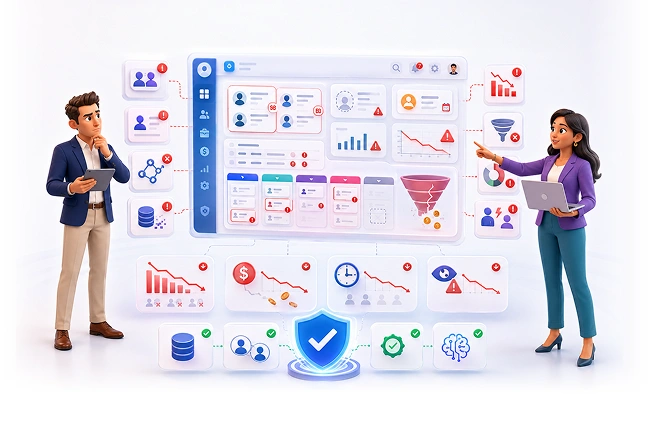
The three culprits behind poor pipeline visibility are consistent across industries: duplicate records, outdated contacts, and missing fields.
Duplicate records create the illusion of a bigger pipeline than you actually have. When a prospect appears in the system as three separate contacts different spellings of the name, different email formats, different owners every rep thinks someone else is handling it. Nobody is. Duplicate records account for between 15% and 30% of most contact databases, and in practice they don’t just inflate numbers; they erode trust. Once a rep gets burned following up on a deal that another rep has already closed or killed, they start working around the CRM rather than through it.
Outdated contacts are the quieter killer. People change jobs. Companies get acquired. Decision-makers move on. B2B contact data decays at a rate somewhere between 22.5% and 70.3% annually, which means that even if your data was clean when you imported it, a significant portion of it is already wrong by the time your next campaign runs. Reps end up spending real selling time chasing ghosts, calling numbers that ring out, emailing addresses that bounce, preparing for conversations with contacts who no longer hold the authority to buy anything.
Missing fields compound both problems. When deal stage, close date, lead source, or contract value are left blank- and they routinely are, because data entry feels like administrative overhead to quota-carrying reps- any report you generate from that data is structurally unreliable. You can’t run meaningful forecasting. You can’t identify which lead sources are actually converting. You can’t make resource allocation decisions with any confidence.
Validity’s 2025 report found that 76% of organizations said less than half their CRM data is accurate and complete, and yet 90% of those same organizations recognize CRM data as the cornerstone of their operations. That gap between stated importance and actual quality is where deals quietly disappear.
The Math: What Bad Data Is Actually Costing You
Revenue leaders tend to frame CRM data quality as an operational issue, something to fix when there’s bandwidth. The financial reality makes a compelling case for treating it as an urgent business priority.
Gartner estimates that poor data quality costs organizations an average of $12.9 million per year. That figure accounts for wasted sales rep time, failed marketing automation, inaccurate forecasting, and missed opportunities. For a mid-market company, it’s a number that tends to exceed the entire annual marketing budget.
The time drain alone tells a significant story. Sales reps waste approximately 27% of their productive time, around 550 hours per year, dealing with bad or missing data. That’s time spent manually looking up contact information, reconciling duplicate accounts, updating records that should have been complete on entry, or simply deciding which version of a record to trust. At standard fully-loaded rep costs, that’s tens of thousands of dollars per headcount per year that never touches actual selling.
Now translate that into opportunities. Validity’s 2025 data shows that companies lose an average of 16 sales opportunities per quarter from unreliable CRM data. Sixty-four deals per year, gone not because the product wasn’t right, not because the pricing was off, but because the underlying data infrastructure failed the rep before the conversation ever got started.
Run that against your own average deal size. If your ACV is $40,000, that’s $2.56 million in annual pipeline evaporation. If you’re selling enterprise deals at $150,000 or more, the number becomes difficult to ignore in any board conversation.
And then there’s the investment comparison. On average, each bad record costs between $10 and $100 to fix across a database of 100,000 records; that’s potentially $10 million in lost revenue. By contrast, a dedicated data quality solution, or a CRM built with validation enforced at the point of entry, costs a fraction of what you’re losing on the back end. The ROI math is not subtle.
IBM’s research on big data value found that poor data quality costs the US economy an estimated $3.1 trillion per year, and the same report noted that one in three business leaders do not trust the information they use to make decisions. That final figure is worth sitting with. If your CRM is the basis of your pipeline calls, your board reporting, and your territory planning, and a third of the people in your organization don’t trust what it’s telling them, what decisions are quietly being made on instinct instead of data?
What Automated Data Validation Actually Looks Like in a Modern CRM
The response to bad CRM data used to be the “data cleanup project,” a periodic, painful, manually intensive effort to reconcile duplicates, re-verify contact details, and fill in missing fields. These projects work for about six weeks. Then data entropy sets back in.
Modern CRM architecture takes a different approach: enforce quality at the point of entry, not after the fact. The features that make this possible aren’t exotic; they’re table-stakes capabilities that sales teams should be demanding from any platform they evaluate.
Mandatory field validation is the first and most fundamental. A CRM that allows a deal to move through the pipeline without a close date, decision-maker contact, or deal value isn’t managing a pipeline; it’s hosting a wishlist. Validation rules that prevent stage progression until required fields are completed eliminate the most common sources of missing data, without requiring ongoing human audits.
Real-time duplicate detection identifies matching records at the point of creation before a second record is saved rather than waiting for a quarterly cleanup cycle. The best implementations go beyond exact-match logic and use fuzzy matching to catch variations in company name formatting, misspelled contacts, or alternate email domains for the same individual.
Contact verification and enrichment, either built into the CRM or through tight integrations with data providers, flags records when email addresses bounce, phone numbers are invalid, or job titles have changed. Rather than discovering that a contact left the company when the rep is already on the first follow-up call, the system surfaces the discrepancy proactively.
Activity-based data decay alerts prompt account owners when a contact or opportunity hasn’t had meaningful engagement in a defined window. This is not the same as a task reminder. It’s a systemic signal that a record may be going stale, prompting a verify-or-close action before the deal quietly ages off the forecast.
Standardized picklists and controlled taxonomy are underrated. When industry type, lead source, or product interest are free-text fields, your reporting becomes ungovernable. When they’re controlled lists, every report, segment, and forecast is built on consistent definitions, and you can actually trust the numbers you’re presenting to leadership.
How iSales CRM Approaches Data Integrity by Design
The distinction between patching data quality and building it into the architecture is where most CRM platforms fall short. The typical approach is to sell the platform, then offer data quality as an add-on, a professional services engagement, or a third-party integration. By the time the problem is addressed, the database is already compromised.
iSales CRM takes the position that data integrity is not a feature; it’s a structural requirement. The platform is built around the principle that a sales rep should never be able to move a deal forward on incomplete information, and that the system should make it harder to create bad data than to create clean data.
Validation rules are configurable at the pipeline stage level, meaning different deal types can enforce different required fields without applying a one-size-fits-all template. Duplicate detection runs at record creation, and surfaces merge suggestions in the workflow, rather than generating a report that someone has to act on separately. Field-level completeness scoring gives Sales Ops a real-time view of data health across the entire pipeline, not just a snapshot during quarterly reviews.
The result is that data quality becomes a byproduct of normal workflow, not an additional responsibility layered on top of selling.
For Sales VPs, that means pipeline reports they can actually use for forecasting, not documents that require twenty minutes of mental adjustment before they’re presentable. For CTOs, it means a CRM that integrates reliably with downstream tools marketing automation, BI platforms, AI scoring models without requiring a data transformation layer to compensate for what the CRM didn’t capture correctly.
Your CRM should be a source of confidence, not uncertainty. If duplicate records, outdated contacts, and incomplete data are affecting sales performance, it’s time for a smarter approach. Explore how iSales CRM helps organizations build data integrity into every stage of the sales process.
Our FAQ
Frequently Asked Questions
CRM data quality refers to the accuracy, completeness, consistency, and reliability of customer and sales information stored in a CRM system. High-quality data enables better forecasting, sales execution, customer engagement, and decision-making.
Poor CRM data can lead to missed opportunities, duplicate outreach, inaccurate forecasts, wasted sales effort, and lower conversion rates, ultimately reducing revenue growth.
The most common issues include duplicate records, outdated contact information, incomplete fields, inconsistent data formats, and inaccurate account details.
The financial impact varies by company size and deal value, but organizations frequently experience lost opportunities, reduced productivity, and forecasting errors that collectively result in substantial revenue leakage.
Customer data naturally changes as people switch jobs, companies merge, contact details change, and organizational structures evolve. Without ongoing maintenance, CRM records quickly become outdated.
Duplicate records can create ownership conflicts, inaccurate pipeline reporting, duplicated outreach efforts, and confusion about account activity, leading to missed opportunities and reduced productivity.
Automated CRM data validation uses predefined rules and workflows to ensure required information is entered correctly, prevent duplicates, verify contact details, and maintain consistent data quality across the system.
AI systems rely on accurate data for forecasting, lead scoring, personalization, and analytics. Poor CRM data can produce inaccurate recommendations, flawed predictions, and ineffective automation outcomes.
Key features include mandatory field validation, duplicate detection, contact verification, data enrichment, activity monitoring, standardized picklists, and automated data governance workflows.
While continuous monitoring is ideal, organizations should conduct formal CRM data quality audits at least quarterly to identify inaccuracies, remove duplicates, update contacts, and ensure reporting reliability.
